
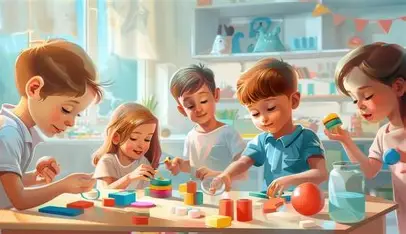
Children desire things that are authentic and real because this is how they understand the world around them. Montessori believes that children can’t grasp the concept of fantasy before the age of six because they don’t even fully comprehend everything that is real and not real in their world yet. Not being taught what is real and what is not real in life can be damaging to the child’s mind. In Montessori, imagination is encouraged when it is connected to reality. The Montessori materials promote use of their imagination during work activities and they are encouraged to use pretend imagination during their free time.
We will explore the difference between imagination and fantasy. Maria Montessori had a strong view about imagination and how children use it to broaden their view of the world and fill in gaps of things they haven’t learned yet. Imagination is encouraged and opportunities are adequately and responsibly provided in the Montessori environment for the child to use their imagination.
The Difference Between Imagination and Fantasy
Fantasy and imagination are not the same. Fantasy is telling a child a story that is impossible to ever come true, while imagination is a telling a child something authentic that a child understands about the world and this will lead them develop a deeper understand of their world and how it works. Fantasy contradicts what a child understands about what is real in the world and this can lead to confusion and inability to form a deeper understanding of things that are real. When children are given new information about things in the world that are real, they are able to make connections to things they already know that are similar. That is how they learn and understand how they fit into their environment. The child can use their imagination to fill in the gaps of things they don’t know.
In the Montessori classroom there are so many opportunities for children to use their imagination. There are pictures of places all over the world that they can look at and globes that show our earth. They can do a work in practical life and see real fruit instead of plastic fruit. They can cut up the fruit and stack it up and eat with a friend and pretend they are having a picnic. In sensorial they can play with blocks and build something new using their imagination and creativity. A child can go to the science area and observe an animal and then pretend they are that animal. They could touch the planets and pretend they are an astronaut going to explore space. They can put a puzzle map of the world together and explore where they are in the world. In the art area, they can look at paintings by different artists and then create their own version of a famous piece of art. In the reading area they can read a non-fiction about dogs and imagine what it would be like to play with each dog they learn about. The child would enjoy that more than reading a make- believe book about a make-believe character named Scooby Doo who doesn’t look real or do real things that a dog does. They could use their imaginations in both scenarios, but how could they connect Scooby Doo to reality and how dogs fit into that reality? The Montessori classroom is filled with opportunities to use imagination and creativity that fits into their real world.
Imagination is natural to the human mind and it’s how children learn about the amazing world they live in. Montessori brings out the wonder, creativity and imaginations of children every day in the classroom based on the amazing real world they live in. Montessori believes that fantasy can be interesting to children after the age six when they are able to understand the difference between what’s real and what’s not real. Before the age of around six it can be damaging to their learning because they don’t really understand what is not real and what is real yet. The world is so new to a young child and it so awe-inspiring, that don’t need any fantasy to make it more interesting. They would rather learn about how amazing real horses are than learn about a unicorn that they will never be able to find in the real world!
Montessori’s Views of Imagination and Fantasy Compared to Mine
Maria Montessori said, “Human consciousness comes into the world as a flaming ball of imagination. Everything invented by man, physical or mental, is the fruit of someone’s imagination. In the study of history and geography we are helpless without imagination, and when we propose to introduce the universe to the child, what but imagination can be of use to us? The secret of good teaching is to regard the child’s intelligence as a fertile field in which seeds may be sown, to grow under the heat of flaming imagination. Our aim therefore is not merely to make the child understand, and still less to force him to memorize, but so to touch his imagination as to enthuse him to his inmost core.” (Maria Montessori, 1989, To Educate the Human Potential)
Maria Montessori believes that learning can’t happen from just absorbing knowledge, it can only happen when it is “grown under the heat of flaming imagination.” The imagination should be developed based on the real world and not on fairy tales and cartoon characters. Maria Montessori connects imagination to intelligence so it important to give children knowledge of their world and let their curiosity lead them to learning and exploration on their own. As Maria Montessori states, “the child has a type of mind that absorbs knowledge and instructs himself.” (Maria Montessori, 1995. The Absorbent Mind). Children need to absorb real knowledge about the real world that they live. This is how they instruct themselves based on reality they see as true all around them, and not fantasy that can never come true.
The lessons in a Montessori classroom are all real-world lessons. All the pictures in the Montessori classroom reflect the real-world. Montessori encourages non-fiction books over fiction books. The Montessori method is based on reality and not fantasy. This is because children prefer reality over fantasy.
Does The Montessori Classroom Adequately and Responsibly Provide a Climate For Imagination?
The environment of a Montessori classroom has works that are all reality-based activities that we do in real life on a daily basis. These activities, however, inspire the imagination in children. There is a kitchen area where children can do activities with food just like they would in real-life. They can pretend to be a chef or pretend they are a grown up preparing a meal. In the science area they can use their imaginations when they observe small animals with a magnifying glass and pretend they are an insect. Children use their imagination in a Montessori environment to build forts with blankets, dig for fossils in a mystery dig box, building the Taj Mahal with blocks, cut up vegetables to form an animal shaped snack to eat, use a real tea set to have tea party with a friend.
In a Montessori environment children use all their senses to learn about the world, which ignites their imagination and creativity. They naturally construct their own images in their mind and role-play based on what they are learning and seeing in the environment. The Montessori classroom provides countless opportunities to ignite imagination and awe in the mind of a child.
Conclusion
Children desire things that are authentic and real because this is how they understand the world around them. The Montessori environment promotes and encourages use of their imagination in everything they do.
There is a difference between imagination and fantasy. Maria Montessori believed that imagination is what children use it to broaden their view of the world. Imagination is encouraged in the Montessori environment and the classrooms adequately and responsibly provide a climate for imagination.