
“We see the figure of the child who stands before us with his arms held open, beckoning humanity to follow. ” (Maria Montessori Education and Peace, p. 119). Maria Montessori believes that the adult should “Follow the child.” The child knows innately what and when they need to learn. It is the role of the guide to follow them in the their path of interest and then get out of the way and let them explore their joyful learning. This also holds true for a child’s innate qualities that lead them to pursue a peaceful approach to life.
The core philosophy of Montessori is based on peace. Montessori teaches peace in the classroom and in life outside of the classroom. This essay discuss what peace looks like in a Montessori classroom and how and a child can contribute to peace. In this essay we will explore how to follow the child so they can lead us all to a peaceful future.
Maria Montessori
Montessori recognizes children as critical to creating a world of peace and tolerance, with no war. Children need to taught peace in school in order to develop them to be peaceful adults with a peaceful approach to life. The whole classroom environment should reflect peace.
Maria Montessori worried a lot about war. She was passionate about helping to create a peaceful world without war. She was also passionate about children. She made the connection to education and peace in her writings and lectures. She argued that education was a way to eliminate war. She believed that children should receive a spiritual and moral education that teaches responsibility, diversity, respect, and peaceful problem solving in order to eliminate future war. She believed teaching peace was just as important as teaching math, reading, and science. Maria Montessori wrote in Education and Peace, “Peace is a goal that can only be attained through common accord, and the means to achieve this unity for peace are twofold: first, an immediate effort to resolve conflicts without recourse to violence—in other words, to prevent war—and second, a long-term effort to establish a lasting peace among men” (Montessori, 1949, p. 27).
How Can Peace Be Promoted In The Montessori Classroom?
There are many ways to promote peace in the Montessori classroom. Peace is a word that needs to be defined and explored with students. They need to know that they have the power to make peace in their environment. Montessori guides and students can model and role-play peaceful resolution skills that they can use in different situations that they encounter in their lives. They can talk about peaceful ways to resolve conflict and define and discuss compromise, taking turns, and listening skills.
One conflict resolution strategy is to have a rock or a shell that students can use to monitor who will be taling when resolving a conflict with each other. I use this at my peace table. The students face each other and whoever is holding the rock or shell gets to talk. No one can interrupt, and once the rock or shell is passed on, the next person gets to talk.
Another technique for students to learn how to share lessons and respect personal space is to explicitly teach grace and courtesy lessons. I spend the first six weeks of school discussing and modeling grace and courtesy lessons. They learn how to care and respect self, others, and the environment. They learn basic self-care skills, social skills, and to care for materials in the classroom and how their behavior affects others. Children learn how to care for their classroom also to care for animals and plants in their environment.
An important part of the peace curriculum is studying geography, history, and other cultures. This emphasizes respect for the diversity of traditions and customs found around the world. Families can be invited into the classroom to talk about their cultures. Of course, the most important part of creating a peaceful environment is to model peace and kindness consistently in the classroom. Children are always watching, learning, and mimicking what they see and hear.
Peace Corner
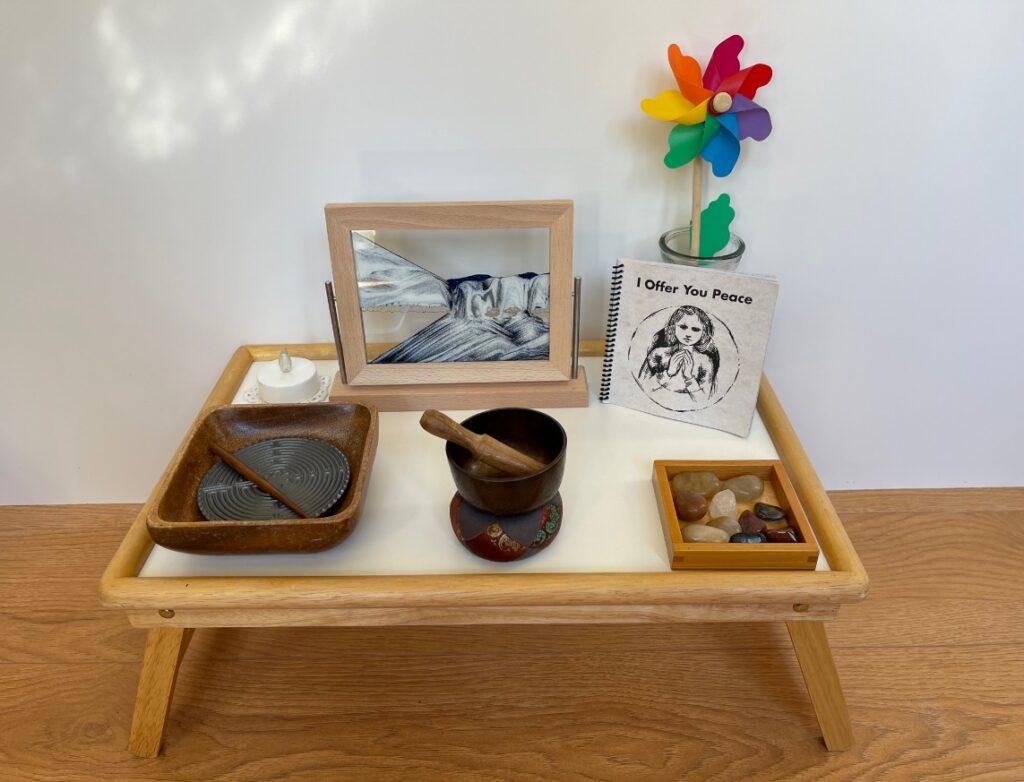
A peace corner is a quiet space in the room with a table and comforting peaceful objects and books. My favorite part of my Montessori classroom is the peace area. This has helped my students to be respectful to each other and they learn how to problem solve on their own. The classroom runs smoothly and efficiently with the child taking control of their behavior.
In the peace corner I had a table, a rose, a rock, some shells, some pillows, a glitter jar, and peaceful books. The students should know that the peace area is not a time out or punishment. Instead, when a child is upset, I ask the child if they want to go to the peace area to calm down. This is a redirection from their issue and the items on the table help them to self-regulate their feelings. They can invite another student to the peace area to talk and problem solve an issue that they have together. In the beginning it requires a lot of teacher guidance, but once they learn how to use it, I found the that they use it on their own and the classroom runs peacefully.
Conclusion
Montessori teaches peace in the classroom, and in life outside of the classroom. There are many strategies that can be used in the classroom and home to create a peaceful environment and peaceful child. One important strategy is the peace corner and teaching children grace and courtesy lessons that they can use to solve problems in peaceful ways. Children can contribute to peace in their daily lives instead of looking at peace as a global problem that they don’t have control over. The most important point of this essay to remember is that children all want peace. It is the role of adults to guide them and then follow the child into a peaceful future.