
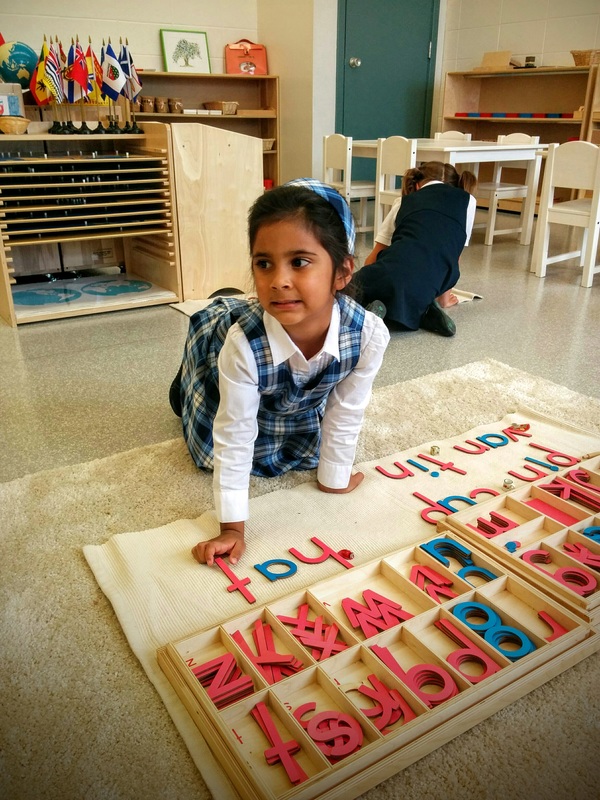
Normalization “is the most important single result of our whole work.” (Maria Montessori, 1995). Montessori states, in the Absorbent Mind, that that all characteristics or behaviors in a child that are either good or bad, disappear “as soon as the children become absorbed in a piece of work that attracts them.” (Montessori, 1995). When children find a work that interests them, they become completely absorbed in the work with no thoughts of being good or bad. The only thoughts they have are complete concentration on their work which brings them peace and joy. This process is called normalization which comes through intense concentration on one’s work. Stages to achieve normalization, how long it takes to normalize a child, and what it looks like will be explored from my personal experiences.
Normalization
Normalization is when children in a Montessori environment choose their own work and intensely concentrate on it while showing self-discipline and peacefulness. Maria Montessori states that children go through phases to reach normalization. The first stage is when the child does something just because they want to do it. The next phase is when a child does things that they are asked to do. Finally, the third phase is when is when a child does something because they understand it is the right thing to do.
In my experiences with normalization, children who are not normalized go through the stages more quickly when they can learn from experienced students by watching and learning from them. I have always had a few students who were normalized that made good role models for students to learn from. The process takes a lot of patience on the part of the child and the guide. Every student will normalization at their own pace, when they are ready.
The normalized student is the most wonderful thing to experience. They pursue peace and harmony in their environment and are respectful of their environment and others. They are very independent and reach out to help others when needed without being asked. They exercise self-control and patience that most adults can’t do. As a matter of fact, I had one student who told me she was helping her dad with self-control and patience because sometimes he would come home from work angry and have no patience to enjoy any fun activities. She taught him to walk the line at home, make silence, and she taught him some yoga moves that she learned in class! With my normalized students, I notice that they can take an interest in anything we do because they have such a good ability to concentrate and focus. “In the normalized child, his freedom to take an interest in all kinds of things, leads to his focusing his attention… on the knowledge he derives from them” (The Absorbent Mind, 1995).
In the Montessori environment, the child will naturally go through the stages of normalization by working on the Montessori materials. They learn how to choose and work on a lesson independently, focus on their work, and can get instant feedback on their work with the built-in self-correction. The normalized student will want to repeat the lessons in order to attain mastery. After mastering a lesson the normalized student will be interested to go to the next lesson. My experience is that the student will get intrinsic satisfaction from mastering a lesson rather than extrinsic satisfaction from a reward or praise. Coming from a conventional teaching background this was shocking to me. In the Montessori classroom I had to learn to refrain from praise and rewarding students because it would be detrimental to the normalization process. Part of normalization is for a student to be able to find inner joy from work well done.
How Long Does It Take To Normalize And How Do You Know A Child Is Normalized?
The process of normalization occurs at a different pace for each individual child. When the child routinely participates in the work cycle each day and repeats activities, that will lead to normalization. Students gather their materials from the shelf and then begin their work. The works take focus and concentration. They become engaged in the work an develop more and more self-control and focus. I have watched students focus very deeply and then put lesson away to walk the line, have a snack, or do some yoga. Then they will take the same lesson out again and repeat the process with deep concentration and joy. Once a child is done with a lesson, the child has an inner sense of satisfaction. Students take good care to put the lesson away carefully so that another student can find the lesson the same way they did. This respect for others while sharing the lessons is a major part of normalization.
Normalized students will show a love of work. In my classroom, I have observed students who always want to do the same work and spend the entire work cycle on it, even though they have already done it many times before. They get joy from being able to choose a work on their own that is connected to their personal interests. The normalized child shows intense concentration. I was amazed one day when I left the room for a little while. My assistant remained in the room to watch the students. When I came back everything was exactly as I left it. Students were busy concentrating on their work. It was quiet and peaceful and the students didn’t even know I had left. When I saw this happen for the first time, I realized that normalization works and I amazed at how effective it was. All the years I spent as a teacher doing the opposite of the Montessori method created nothing but a chaotic and unenthusiastic environment with plenty of behavior issues. Now I wasn’t interrupting their learning and everything was running smoothly.
It takes work to normalize the students, but once you have a normalized class everything runs peacefully on its own. I found that it is very important to reinforce grace and courtesy and practical life activities in the beginning of the year. These are a great start to a peaceful, orderly classroom where normalized children will develop. The grace and courtesy and practical life lessons at the beginning of the year teach students how to be respectful to others, how to problem solve to bring peace, how to control their bodies, how to show manners, and how to take care of self and the environment. They learn how to roll a mat, take out a lesson and put it away, how to ask for help, how to walk the line, carry a tray, and tuck in a chair. These are all activities that help the child become oriented to the prepared environment and how to respect and use the materials, and how to interact appropriately with others. These lessons are an important aspect of the path to normalization. I found in my classroom that the older, normalized, and experienced children love to teach the new and inexperienced children. They are a great help in the normalization process. Instead of modeling many of the grace and courtesy lessons myself, I found it effective to have a normalized student model the lessons to other students.
Conclusion
Normalization is the most amazing part of the Montessori Method. I remember my amazement when I saw it in action. It still amazes me to be in a classroom filled with happy, peaceful, and engaged students who are all working on something different. It brings me joy to see students helping each other and getting such satisfaction from within themselves for a work well done. It is amazing to watch and be a part of joyful learning!