
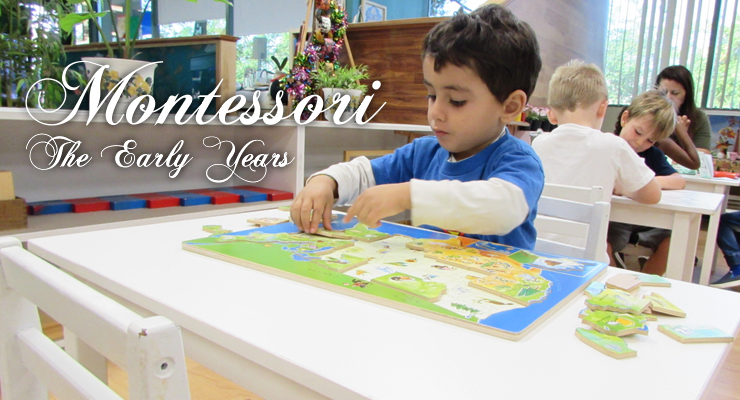
The Montessori philosophy stresses that the years from birth to six years old are the formative years. In this essay I will be exploring this important period in the child’s life where the mind is so absorbent that they will learn very quickly and form their general intelligence and personality. The sensitive period will be discussed and when children are sensitive to learning specific skills. I will discuss how I, as a Montessori guide, aid my students in their development in the formative years.
It is critical to develop the child during the formative years because, as Maria Montessori states, only during these years will a child “incarnate in himself the things which he sees and hears i.e., in us there is no change, in the child transformations take place. We merely remember an environment while the child adapts himself to it.” (Absorbent Mind, 1995, Page 98).
The Absorbent Mind
During the first six years of life, children have a sponge-like brain. They can continuously learn huge amounts of information from their environment. Maria Montessori states in, Montessori: A Modern Approach, that the Absorbent Mind is the special quality and process that a child has to learn. The child’s mind is not yet formed, so they learn in a different way than adults. “Impressions do not merely enter his mind, they form it, they incarnate themselves in him” (Montessori: A Modern Approach, 1972, pages 29-49). These formative years are critical because they develop most of their brain and personality during this time.
There are two categories of the absorbent mind. One is the unconscious learning that a child does from birth to three years old. This is when they learn to walk, run, stand, and speak without conscious effort of the learning. They will mimic and quickly learn from everything that they see in their environment.
The conscious category is when the child is 3-6. They will consciously seek out learning that interests them and naturally gravitate toward learning things like order, sequencing, early math, music, and letter shapes and sounds. The Montessori lessons are made to appeal to the students interests at this phase. The child at this age will also continue to develop their physical movement, balance, and control. When students practice walking the line work in the classroom, they are developing their balance, control of their body, and ability to focus. Children in the conscious phase of learning want to do things independently and make their own choices in their work. The Montessori guide will prepare the environment so that they can work independently and freely choose their own lessons. The prepared environment is important because the lessons are ready on the shelves for the student to choose to work on independently and they appeal to the child’s desire for things to be ordered, sequenced, and beautiful. As adults we see the environment and remember it, but children absorb the environment and make it part of their personality.
The Sensitive Period
The Sensitive Period is the way a child learns from their environment. There is a pattern that a child follows in their learning when they have an intense desire to learn specific things at specific times in their life. From birth to one year of age, children are at the sensitive period for learning with movement. They need to touch everything and be free to walk and balance things. In the classroom the child is free to move around the classroom and touch the lessons. Beginning at one year of age they are obsessed with small objects and details. The Montessori lessons are set up to be visually attractive and many contain small interesting objects to support their learning.
Children from birth to four years old desire order and repetition. They want everything in it’s place and a place for everything. The lessons on the shelves should be neat and orderly and allow a child to be able to take out a lesson whenever they want to practice. This fulfills their desire for repetition in their learning.
During the ages of 2-6, students have a desire to be polite and kind. They imitate polite and courteous behaviors that they see and they want to learn manners. The grace and courtesy lessons fulfill these learning desires at this sensitive period. At this stage of learning the child is fascinated with taste, sound, touch and smell. The Montessori sensorial lessons are made to refine their sensorial discrimination skills.
Later, between the ages of 3-5, students become interested in letters, numbers and letter sounds. They use their finger to learn to write before using a paper and pencil and they learn to write before reading. New vocabulary and expressive language is continually introduced to students in all the lessons from birth to six years of age.
Students sensitive period to math starts at birth up to age six. They learn from touching and working with concrete lesson materials. All students have a desire for music, dance, and art. I try to incorporate music, art, and dance in everything I do throughout the day in the classroom. Puzzles and maps are important for children 4-6 when they want to develop their spatial relationship skills.
How I Aid The Young Child’s Normal Development During The Formative Years
My role as a Montessori guide is to recognize that children intensely desire knowledge and mastery of learning. I show them how to do a lesson so that they can do it on their own. They will naturally want to practice what they have learned until they master the activity. I can guide them and give them the freedom to choose their own work that they have a desire to work on based on their active inner sensitive period. I can aid the child in their development by not interrupting the process of learning, not offering unsolicited help, and not praising or punishing a student for their work. They feel internal satisfaction from good work and perseverance to continue working for lessons they still need to master. I also can aid the child by not correcting their work. The lessons are set up for students to correct their own errors, and with practice they can master the skill on their own.
The most important thing I can do as a Montessori guide is to create excitement for learning. I create an interesting and orderly prepared environment, and model strategies to help with concentration, focus, and control so that they can absorb as much as possible in their learning. I follow the student and meet them where they are at. We both know that ‘where they are at’ is the perfect place for them to be!
As a Montessori guide I am not just working with the student’s mind, I am nurturing their mind, body, and spirit. I nurture the whole child, not just the mind. This means that the classroom and activities fill the spirit of the students and engage all their senses. The room is beautiful and they are free to learn what interests them. They have contact with nature and learn to appreciate different cultures around the world.
In my classroom we role-play different scenarios in order to teach the child how to problem solve by themselves. I have a peace table for students to use as a space to become mindful and help themselves find inner peace. This creates a classroom community that is peaceful and self-disciplined. Music, art, and beauty, freedom, and peace can be found all around in my classroom. This is what I intentionally prepare each and every day in order to aid my students’ development during the formative years.
Conclusion
The formative years in a child’s life from 0-6 years of age are so critically important because the mind is so absorbent that they will learn very quickly and form their general intelligence and personality. The child goes through sensitive periods where they are sensitive to learning specific skills. My experience, as a Montessori Guide, has allowed me to experience the amazing absorbent mind of children in the primary classroom. I aid the children in their learning by preparing an interesting and engaging environment where the student can develop independently and have the freedom to choose their learning activities.
It is important to remember that the absorbent mind doesn’t like to learn sitting still at a desk with a worksheet or book and a teacher at the front of the class teaching everyone the same thing at the same time. The absorbent mind needs to learn through experiencing the world and interacting with learning materials that they can touch, explore, observe, and interact with. They need to learn at their special time and in connection with their special interests.