
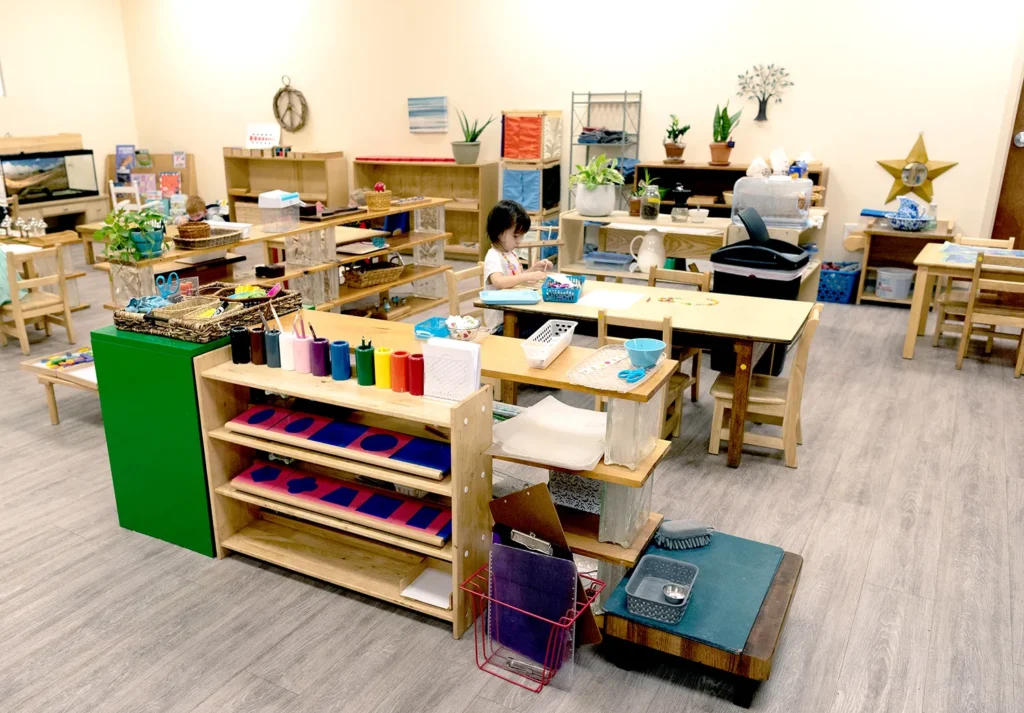
The prepared environment is the most important influence on how a child will learn in a Montessori classroom. It is up the Montessori guide to make sure the materials are organized and sequenced with all the supplies that are needed for the students to be able to work on them independently. The Montessori assistant needs to make sure that supplies are in their place each day and restocked so that the students will have what they need to succeed in their learning. It is up to the Montessori guide to prepare the environment so that it is ordered, and peaceful with no clutter or distracting colors on the walls. The Montessori environment that is prepared and maintained by the Montessori guide and assistant is what creates the opportunity for the child to get the most out of their sensitive periods of development and experience a joyful and peaceful learning experience.
Beauty And Order
Children love a beautiful environment. Dr. Maria Montessori created works to be beautiful so that they are enticing to children. The guide prepares the language lessons with small and interesting objects that help children make connections to the learning and engage them. In my classroom I had several objects for each letter sound. They were small and fragile and the children respected them and carried them gently so as not to break them. It always amazed me that the children were so appreciative of having a beautiful environment and being trusted to handle fragile objects that they wanted to respect and take care of the environment. The guide prepares works on attractive trays and in fancy boxes and puts them on the shelves. Montessori states in Dr. Montessori’s Own Handbook, that “there should be varieties of didactic materials fitted and adapted to the child’s intellectual and social development” (Montessori, 1965). The furniture and walls should be have light and natural colors with no distractions. Maria Montessori states in her handbook that this will foster implicit learning of colors. Furniture in the room should be child-sized so they can reach everything. Some of the typical furniture includes wooden chairs, small wooden tables, wooden shelves and cabinets. Beautiful real flower arrangements and plants can be set on tables for the children to care for and to beautify the environment. The Montessori guide can frame copies of artwork by famous artists to put around the room. Children will become familiar with the famous artworks and it adds beauty to the room. The guide should prepare the room with natural light. In my room I had large windows all around the room and only used that natural sunlight to light the room.
An important part of the prepared environment is having order. Maria Montessori believed that children need order to be successful in their learning. There are many materials in the classroom that the child will take off the shelves to use independently. They need to know they will always be in the same place when they want to use the materials again. The Montessori guide needs to put the works in sequential order on the shelves. The Montessori assistant can check to make sure the materials are in the proper place and set up correctly each morning before school starts and at the end of the day. This is important at the beginning of the year, but once students are normalized, they put the works back in their place by themselves neatly. When they know they are in a beautiful and ordered environment, they will work it keep it that way.
Intellectual Features
The Montessori guide’s role is to prepare the Montessori curriculum. The works are carefully organized in logical order and sequenced from left to right. The Montessori guide groups them in different areas of the room such as language arts, mathematics, language, geography, science, practical life, and sensorial. The lessons are put on wooden shelves that are sized for the child to independently take out their own lessons and put them away. The room is prepared for the students so there is no teacher area or desk. Once the room is prepared and students are normalized, then the students take care of it and keep the lessons organized and neat.
Social and Freedom Features
The room is prepared by the Montessori guide so that students can be social with each other. I set up an area for students to do yoga, a tea party table, and a peace corner. The peace corner should be set up so that students can work through and problem solve disagreements or differences. The directress prepares the environment so that the children have freedom of movement with no obstacles. They need freedom to make choices during the work cycle and interact socially or have a quiet place to just rest and think. This environment leads to happy, peaceful and independent learners.
Nature and Reality
Natural and real materials are used in the classroom as much as possible. The Montessori guide sets up a practical life area where there are real items such as kitchen utensils and food for making snacks. In my classroom I had real flowers brought in by a parent each week. The students made flower arrangements with them to place in the classroom or bring home. The dressing frames are made of real fabric, buttons, and zippers. They can also use real locks and latches. The Montessori guide shows the students how to use these items so that they can use them safely on their own.
Outdoor Space
“There must be provision for the child to have contact with nature; to understand and appreciate the order, the harmony and the beauty in nature.”-Maria Montessori.
Maria Montessori thought that nature should be part of the learning environment. Nature was so important to her that she thought that, if possible, there should always be access for the child to go outdoors and there should be no separation between the indoor and outdoor classroom.
There are many learning opportunities outdoors for sensorial activities, physical activity, creativity, and problem solving.
Features in the Outdoor Environment
The outdoor environment should be set up with features for students to experience sensorial activities such as water with floating objects, sand play with shovels, containers and sticks for tracing in the sand. A bucket of rocks for students to sort by texture and color. In my classroom we didn’t have access to a connected outdoor environment or the ability to go outside whenever we wanted, so I did regular nature walks. This was great for physical activity and nature studies. We have a nature hunt checklist for students to find such things as rocks, leaves, and flowers. They each had a paper bag to collect what they found. Back in the classroom they could sort and organize what they found. One time we went out with the older Montessori students’ and we made bird feeders with peanut butter to hang on the trees at Clark Park.
Another great feature in the outdoor area would be a garden. Students can plant seeds and watch them grow and eat what they plant for healthy snacks. They can keep journals of their plant observations and research their plants. Another way to connect the outdoors to learning is simply sit outside under a tree and write, draw, or read a book.
Conclusion
The success of a Montessori classroom has to do with how the guide and assistant take the time to prepare it for independent movement and work, freedom of choice in work activities, and a natural, peaceful and comforting environment. In the Montessori prepared environment, you will find always find beauty, nature, reality, freedom, order, social, and intellectual features that create the opportunity for the child to get the most out of their sensitive periods of development..